
Shi Xiaolin stressed during a research visit to Meishan
that the opening stage shapes the overall situation,
and that it is necessary to start early, work hard and deliver a “good start” for high-quality development.
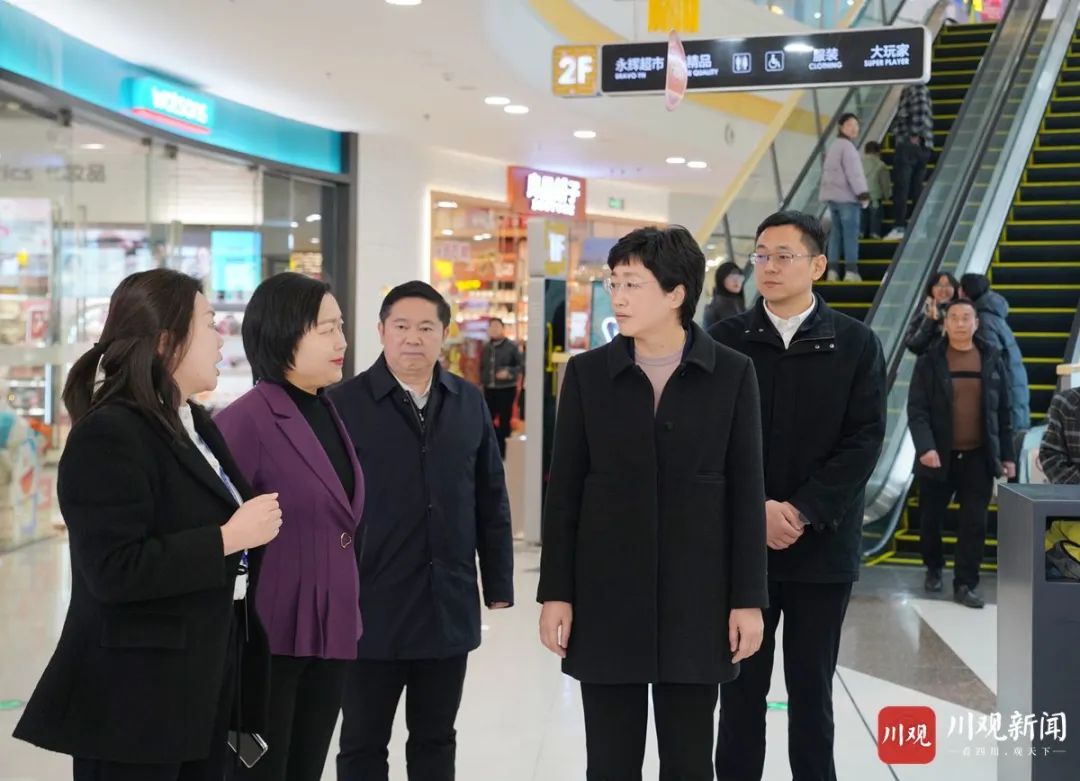
On 13 January, Shi Xiaolin, deputy secretary of the CPC Sichuan Provincial Committee and governor of the province, inspected consumer-goods trade-in and Spring Festival consumption promotion at Wanda Plaza in Dongpo District, Meishan.
Chuanguan News reporter Li Miao; photographs by Tian Wei
On 13 January, Shi Xiaolin, deputy secretary of the CPC Sichuan Provincial Committee and governor of the province, conducted research in Meishan. She stressed the need to implement in depth the spirit of the Central Economic Work Conference and the arrangements of the provincial economic work conference, to lock onto annual targets, and, with a sense of urgency and a spirit of striving to be first, to work hard and tackle difficulties together, striving for a “good start” to high-quality development in the first quarter, and, with solid results, to make Meishan’s contribution to a good start for the province’s work for the year and to the continued improvement of the economy.
Shi Xiaolin visited Wanda Plaza in Dongpo District and the construction site of the Minjiang extra-large bridge on the Chengdu–Meishan municipal (suburban) railway, to inspect consumer-goods trade-in and Spring Festival consumption promotion and the building of a multi-level transport system in the Chengdu metropolitan area. She also went to Huantian Wisdom, Wanhua Chemical (Sichuan) Co., Ltd., the Albemarle Sichuan base project and the Meishan New Energy and New Materials Integration Innovation Centre, to learn about the development of the satellite industry, work on key core technologies and the translation of results, foreign trade, the building of a pilot-test platform system and the progress of practical-training projects.
Shi Xiaolin pointed out that the opening stage shapes the overall situation. It is necessary to start early, take the initiative, seize major opportunities such as the building of a national strategic hinterland and the Chengdu–Chongqing economic circle, identify points of effort while serving the broader picture, advance the integration of Chengdu, Deyang, Meishan and Ziyang and integration across the whole region, and accelerate the fostering of new momentum for high-quality development. High-quality projects should be used to promote investment, making good use of policies such as the “two major” and “two new” programmes, focusing on projects that deliver effective investment, rooted industries and a sustained tax base, and planning and reserving a batch of major, high-quality projects in a wider range of fields including science and technology, environmental protection, energy, computing, urban renewal and modern logistics. Quality supply should be used to promote consumption, with greater effort and a wider scope for consumer-goods trade-in, a continued deepening of “consumption +” actions, integrated development of agriculture, commerce, culture, tourism, sport and health, and the fostering of more new consumption highlights in incremental areas such as the debut economy, the silver economy, the ice-and-snow economy and the night-time economy. Scientific and technological innovation should be vigorously promoted, with organised research campaigns, the joint building and sharing of science and innovation eco-islands, a full role for leading enterprises’ pilot-test platforms, and support policies on pilot-test funding and land, so as to build a “pilot-test +” ecosystem and promote the translation and spillover of innovative results along the way. The building of clusters and the strengthening of chains in key industries should be accelerated, with an industrial-chain evaluation system, a role for industrial investment funds, and the promotion of service models such as science-and-innovation investment, loans, subsidies, insurance and vouchers, continuously improving the industrial ecosystem, advancing the “intelligent upgrading and digital transformation” of manufacturing, helping more enterprises “scale up, make the list, go to the cloud and go public”, and ensuring that industrial carrying areas such as chemical parks hold the environmental bottom line and accelerate quality and efficiency improvements.
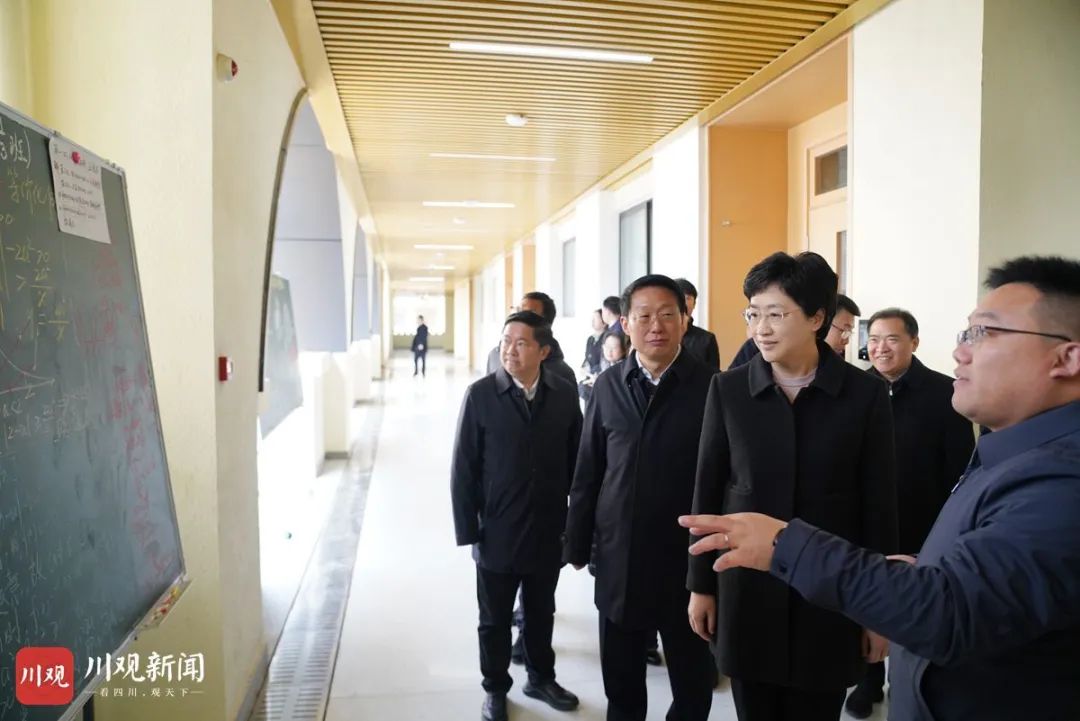
Shi Xiaolin conducted research at Tsinghua University High School Tianfu on the progress of key educational projects in cooperation with Tsinghua University, and on the school’s distinctive operation and admissions.
Shi Xiaolin also visited Tsinghua University High School Tianfu and Sichuan Provincial Children’s Hospital to learn about distinctive schooling and admissions, the building of specialities, and the radiating role of a national regional medical centre. She stressed the need to compile a “public-service population map” in light of changes in population and demand, to let public services follow people, to coordinate the allocation of resources and the layout of projects in education, healthcare, elderly care and culture, and to build more good schools, hospitals and centres close to people’s homes, continuously raising the quality and effectiveness of work on people’s livelihoods. Reform-minded approaches should be used to strengthen school–local and hospital–local linkages, promote the open sharing of quality courses and teaching staff, explore new paths for a paediatric tiered diagnosis and treatment system and for children’s overall health and young people’s mental-health services, actively develop the health industry, and better promote high-quality, balanced development of basic public services between regions and between urban and rural areas.
Zeng Qing, secretary-general of the provincial government, and responsible comrades from relevant provincial departments and from Meishan, took part.